- Article Summary
-
Introduction
For decades, electricity demand in the United States remained largely flat, even as the economy expanded and digital technologies transformed daily life. Efficiency gains offset growth, allowing the power system to decarbonize gradually without major pressure to expand total capacity. That era is now over. According to recent analysis, the US is entering a period of sustained electricity demand growth driven by structural economic and technological shifts rather than short-term cycles. This change marks a turning point for the energy transition. The challenge facing the power sector is no longer framed solely around emissions reduction. It now centers equally on whether the system can deliver enough electricity, reliably and quickly, to meet accelerating demand while still progressing toward climate goals.
The End of Flat Electricity Demand in the United States
The long period of stagnant US electricity demand was the result of several reinforcing trends, including improved appliance efficiency, slower industrial growth, and the offshoring of energy-intensive manufacturing. These conditions allowed utilities and policymakers to plan for a stable load environment. Recent projections show a decisive break from this pattern. Electricity demand is now expected to rise steadily through the 2030s as new sources of load come online. Unlike past demand growth driven by population increases, this surge is concentrated in specific sectors and regions, creating localized stress on generation and transmission infrastructure. The return of demand growth fundamentally alters the assumptions underlying power system planning, investment timelines, and climate strategy.
Data Centers and Artificial Intelligence Drive Load Concentration
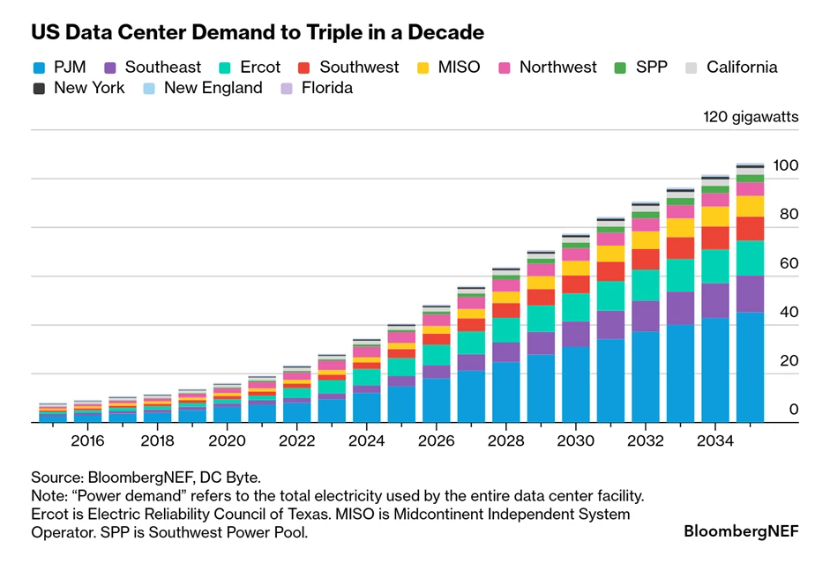
One of the most significant contributors to rising electricity demand is the rapid expansion of data centers, particularly those supporting artificial intelligence workloads. AI-driven computing requires continuous, high-density power that cannot easily be shifted in time. This creates large, inflexible loads that must be served around the clock. While national generation capacity may appear sufficient on paper, the geographic concentration of data centers places intense pressure on regional grids. In many cases, transmission constraints and interconnection delays prevent clean generation from reaching these loads, increasing reliance on existing fossil-based resources. The growth of data centers highlights how electricity demand growth is no longer diffuse and predictable, but clustered and urgent.
Electrification and Industrial Reshoring Accelerate Power Needs
- Electric vehicles and charging infrastructure increase baseline electricity demand across urban and highway corridors
- Heat pumps and building electrification shift energy consumption from fossil fuels to the power grid, particularly during peak seasons
- Electrified industrial processes require continuous, high-load power supply to maintain productivity
- Industrial reshoring policies drive new manufacturing capacity that adds large, localized electricity loads
Electrification across transportation, buildings, and industry is another major driver of rising demand. Electric vehicles, heat pumps, and electric industrial processes all increase electricity consumption as they replace direct fossil fuel use. At the same time, industrial reshoring policies are encouraging the return of manufacturing activity to the United States, including clean energy supply chains, semiconductors, and advanced materials. These facilities are energy-intensive and often require firm power supply to operate continuously. While electrification is essential for long-term decarbonization, its near-term effect is to raise electricity demand faster than clean generation and grid infrastructure can be deployed, creating a mismatch that challenges system reliability.

Capacity, Reliability, and Speed Define the New Energy Transition
As electricity demand accelerates, the energy transition is being reshaped around three interdependent constraints. First is capacity. The system must add far more generation and storage than previously planned. Second is reliability. Grid operators must maintain stability even as load profiles change and weather-driven generation expands. Third is speed. Permitting delays, transmission buildout timelines, and interconnection backlogs now represent critical risks to climate progress. If clean capacity cannot be deployed quickly enough to meet rising demand, fossil generation will fill the gap, undermining emissions targets despite strong policy ambition.
Conclusion
Surging US power demand represents a structural shift in the energy transition narrative. The central question is no longer limited to how fast emissions can be reduced, but whether the power system can expand rapidly while remaining reliable and clean. Data centers, electrification, and industrial reshoring are redefining electricity demand in scale, location, and urgency. Navigating this transition successfully will require coordinated investment in generation, grids, and system planning at a pace not seen in decades. The outcome will determine whether rising demand becomes a barrier to climate progress or a catalyst for a more resilient and fully decarbonized power system.
Why Work with ASUENE Inc.?

ASUENE is a key player in carbon accounting, offering a comprehensive platform that measures, reduces, and reports emissions. The company serves over 10,000 clients worldwide with an all-in-one solution that integrates GHG accounting, ESG supply chain management, a Carbon Credit exchange platform, and third-party verification.
Through its energy management system NZero, ASUENE provides SMEs with the practical tools to make the most of EU funding for energy efficiency. NZero combines advanced technology, consulting services, and an extensive partner network to help companies achieve their net-zero goals. By choosing ASUENE, SMEs gain not only access to reliable carbon accounting but also a powerful EMS platform designed to unlock energy savings and long-term sustainability success.