- Article Summary
-
Introduction: CBAM Moves From Transition to Enforcement
The European Union’s Carbon Border Adjustment Mechanism is entering a decisive new phase. After a transitional period focused on reporting and capacity building, CBAM will move into its definitive regime on 1 January 2026. From that point forward, carbon embedded in certain imported goods will carry a direct financial cost at the EU border. This shift represents more than a technical policy update. It signals the EU’s intention to fully integrate carbon pricing into international trade and to ensure that climate ambition is not undermined by global supply chain dynamics.
During the transitional phase that began in October 2023, importers were required to report embedded emissions without paying a carbon price. This period was designed to give businesses time to build emissions data systems, engage suppliers, and understand compliance obligations. The definitive phase changes that balance. Reporting will be paired with mandatory certificate purchases, aligning imported goods with the carbon costs already faced by EU producers under the EU Emissions Trading System.
As the EU accelerates toward its 2050 climate neutrality target, CBAM is becoming a permanent enforcement mechanism rather than a preparatory exercise. The planned expansion to downstream products reinforces this shift, extending carbon accountability beyond raw materials into the heart of global manufacturing supply chains.
CBAM Today: How the Definitive Regime Will Work From 2026
From 2026, EU importers of CBAM goods or their indirect customs representatives will be required to hold the status of authorized CBAM declarants. Authorization is not optional. Importers exceeding the single mass based threshold of 50 tonnes of CBAM goods will need to apply through the EU’s Authorisation Management Module before importing covered products.
Authorized declarants will be responsible for purchasing CBAM certificates from national authorities in their country of establishment. Certificate prices will be linked directly to the EU ETS, calculated as a quarterly average of auction prices in 2026 and as a weekly average from 2027 onward. This pricing structure ensures that imported goods face a carbon cost equivalent to that borne by EU producers.
Each year, importers must declare the total emissions embedded in their imported CBAM goods and surrender a corresponding number of certificates. Embedded emissions calculations must follow EU methodologies and rely on verified data where available. If an importer can demonstrate that a carbon price has already been paid during production in a third country, the equivalent amount can be deducted from the CBAM obligation.
| CBAM Requirement | Definitive Regime from 2026 |
|---|---|
| Who must comply | EU importers or indirect customs representatives |
| Authorization | Authorized CBAM declarant required |
| Import threshold | More than 50 tonnes of CBAM goods |
| Carbon price basis | EU ETS allowance auction prices |
| Emissions declaration | Annual |
| Certificate surrender | Annual |
| Carbon price deduction | Allowed if paid in country of origin |
These rules transform emissions data into a financial variable. Accuracy, traceability, and documentation will directly affect compliance costs, making emissions accounting a core operational requirement rather than a sustainability reporting exercise.
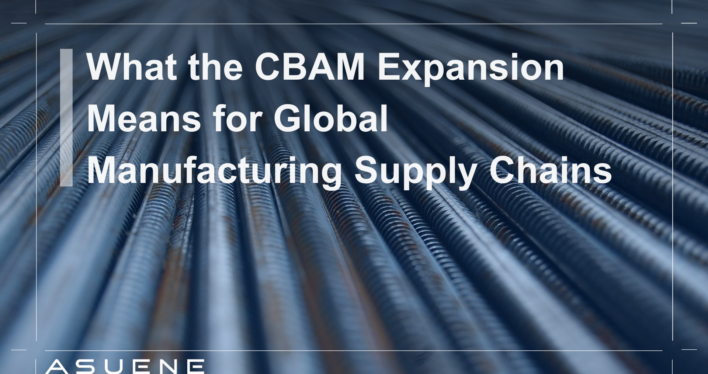
The Expansion of CBAM to Downstream Products
CBAM currently applies to a limited set of basic materials: iron and steel, aluminium, cement, electricity, fertilisers, and hydrogen. These sectors were chosen because of their high emissions intensity and exposure to carbon leakage risks. However, the European Commission has identified a growing gap between regulated materials and the manufactured goods produced using them.
To address this, the EU plans to extend CBAM to around 180 steel and aluminium intensive downstream products from 2028. These products are selected based on a high risk of carbon leakage and a high share of steel and or aluminium content, averaging around 79 percent. While they represent about 15 percent of current CBAM imports by volume, they account for a much larger share by value, at around 53 percent.
Around 94 percent of the downstream goods concerned are industrial supply chain products, including machinery, equipment, vehicle components, and construction goods. The remaining share consists of household products such as domestic appliances. Examples range from simple steel products to complex goods like washing machines that incorporate multiple CBAM inputs.
By extending CBAM to these downstream products, the EU is reinforcing the principle that carbon costs should follow emissions along the value chain, rather than stopping at the point of raw material production.
Why the EU Is Expanding CBAM to Downstream Products
The expansion of CBAM to downstream products is driven by a clear policy concern. As EU producers pay higher carbon costs for steel and aluminium inputs under the EU ETS, their downstream products become more expensive. This creates incentives for production to shift outside the EU or for EU made goods to be replaced by imports from jurisdictions with weaker climate policies. In both cases, emissions are relocated rather than reduced.
Extending CBAM to downstream products is intended to close this loophole. The policy logic behind this move can be summarised as follows:
- EU producers face rising carbon costs for steel and aluminium inputs under the EU ETS
- Downstream EU products become less competitive as input costs increase
- Production risks shifting to jurisdictions with weaker climate policies
- EU markets risk being supplied by carbon intensive imports rather than lower carbon EU goods
- Emissions are relocated along the supply chain rather than reduced overall By applying a carbon price to imported machinery, equipment, and appliances, the EU aims to ensure that climate ambition translates into real emissions reductions rather than changes in trade flows.
The expansion is supported by stronger anti circumvention measures informed by lessons from the transitional period. Reporting requirements are being reinforced to improve traceability and prevent misdeclaration of emissions intensity. The Commission will have the authority to request additional evidence when reported values appear unreliable and to apply default country values in specific cases.
Another important development is the inclusion of pre consumer steel and aluminium scrap in emissions calculations. This change promotes scrap usage while ensuring consistent carbon pricing between EU produced and imported goods. Together, these measures strengthen CBAM’s environmental integrity and reduce opportunities for avoidance.
Conclusion: CBAM Becomes a Supply Chain Carbon Standard
With the start of the definitive regime in 2026 and the planned expansion to downstream products, CBAM is evolving into a supply chain wide carbon standard. It links trade access to emissions transparency and aligns global manufacturing with the EU’s carbon pricing framework.
For global manufacturers and exporters, this shift elevates embedded emissions data to a strategic priority. Procurement decisions, supplier engagement, and production design will increasingly influence compliance costs and market access. CBAM also deepens the connection between trade regulation and Scope 3 emissions, turning value chain emissions into a direct financial consideration.
As CBAM moves from transition to enforcement, early preparation becomes essential. Companies that invest now in robust emissions accounting and decarbonisation strategies will be better positioned to compete in a market where carbon performance is priced, verified, and enforced.
Why Work with ASUENE Inc.?

ASUENE is a key player in carbon accounting, offering a comprehensive platform that measures, reduces, and reports emissions. The company serves over 10,000 clients worldwide with an all-in-one solution that integrates GHG accounting, ESG supply chain management, a Carbon Credit exchange platform, and third-party verification.
ASUENE supports companies in achieving net-zero goals through advanced technology, consulting services, and an extensive network.