- Article Summary
-
Introduction: Why GRI’s New Labor Drafts Matter Now
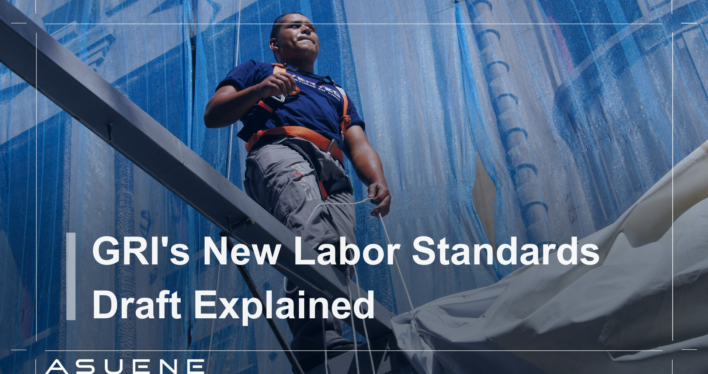
The Global Reporting Initiative has released new exposure drafts for labor and human rights disclosures. The consultation period is open and stakeholders are encouraged to provide input. Labor rights and human rights due diligence are becoming core expectations in global reporting. These draft standards represent a shift toward stronger transparency on workforce impacts across operations and value chains. This blog explains what GRI is, who reports, what has changed in the new drafts, and what companies should prepare for.
What GRI Is and Who Needs to Report
The Global Reporting Initiative is the most widely used sustainability reporting framework in the world. GRI Standards help organizations disclose information about their significant environmental and social impacts. While GRI is voluntary, it is widely expected across global supply chains. Companies often use GRI to meet expectations from customers, investors, lenders, and regulators such as those involved in the European CSRD framework. GRI is not legally mandatory for most organizations, although it has become a practical requirement for companies that need to demonstrate transparency to stakeholders.
The New Draft Labor Standards and the Consultation Period
In December 2025 GRI released exposure drafts for several new labor topic standards. The consultation period runs until March 9 2026. The four draft standards in this phase are:
- Forced Labor
- Child Labor
- Freedom of Association and Collective Bargaining
- Labor Rights in Business Relationships
These drafts represent a major expansion and restructuring of GRI labor-related disclosures. They introduce new categories, increase the depth of disclosure and strengthen expectations for human rights due diligence.
What Is Different About These Draft Standards
The new drafts introduce several major changes that raise expectations for labor and human rights reporting.
New standalone standards
The drafts separate key labor rights topics into individual standards. Forced labor, child labor, freedom of association and collective bargaining and labor rights in business relationships now have their own structures, definitions and disclosure requirements.
Stronger disclosure expectations
Organizations are expected to provide detailed information on human rights due diligence, incident reporting, remediation processes, grievance mechanisms and stakeholder engagement. The drafts set clearer expectations for evidence based practices rather than general statements.
Increased focus on value chain workers
The new Labor Rights in Business Relationships draft expands reporting beyond direct employees. Companies are expected to discuss risks and impacts related to contractors, temporary workers, on site service providers and supply chain workers.
Alignment with international frameworks
The drafts are aligned with the UN Guiding Principles on Business and Human Rights, OECD due diligence guidance and ILO conventions. This alignment supports consistency with other global sustainability and human rights frameworks.
Greater clarity and consistency
The new structure provides clearer definitions and more consistent formatting than previous labor standards. This is intended to support better comparability and usability for organizations and stakeholders.
What Companies Should Prepare For Next
Final standards are expected in late 2026. Most companies will begin reporting under the updated standards in 2027 or 2028 depending on their reporting cycle. Companies can prepare by mapping labor and human rights risks across operations and value chains. They can strengthen due diligence processes, review grievance mechanisms, evaluate supplier requirements and improve data collection for labor related impacts. Early preparation will support a smoother transition once the final standards are released. Organizations are also encouraged to participate in the consultation period to help shape the final standards.
The new GRI draft labor standards represent a significant step forward in global labor and human rights reporting. Companies that prepare early will be better positioned to meet growing stakeholder expectations and regulatory developments.
Why Work with ASUENE Inc.?

ASUENE is a key player in carbon accounting, offering a comprehensive platform that measures, reduces, and reports emissions. The company serves over 10,000 clients worldwide with an all-in-one solution that integrates GHG accounting, ESG supply chain management, a Carbon Credit exchange platform, and third-party verification.
ASUENE supports companies in achieving net-zero goals through advanced technology, consulting services, and an extensive network.