- Article Summary
-
Introduction
Extended Producer Responsibility, or EPR, shifts the financial and operational responsibility for a product’s end-of-life management from local governments to producers. In 2026, the EU is consolidating packaging rules under one directly applicable regulation, while the US continues building a state-by-state patchwork with no federal statute. This guide focuses on packaging, batteries, electronics, and textiles in the EU and the seven enacted US packaging states; it does not cover US state programs for categories such as carpet, mattresses, or paint.
Key Takeaways
- The EU’s Packaging and Packaging Waste Regulation (PPWR) becomes applicable August 12, 2026, adding producer registers and recyclability-linked fees.
- Seven US states have enacted packaging EPR laws: Maine, Oregon, Colorado, California, Minnesota, Maryland, and Washington. No federal law exists.
- Packaging is most mature in both regions. Batteries and electronics are established in the EU and uneven in the US. Textiles are emerging in both, led by California.
- Colorado issued its first producer fee invoices in 2026 based on 2025 supply data; California, Colorado, and Oregon’s next fee cycle, calculated from more detailed 2026 supply reports, begins in 2027.
- Both regions converge on the same operational core: registration, SKU-level data, and recyclability-linked fees, favoring one unified compliance data system over jurisdiction-by-jurisdiction handling.
What Is Extended Producer Responsibility and Why Is It Expanding in 2026?
EPR requires producers, typically brand owners, manufacturers, or importers, to fund and often operate the collection, sorting, and recycling of what they place on the market. Registration, periodic reporting, and recyclability-linked fees recur across nearly every jurisdiction that has adopted this model. 2026 is a pivotal year on both continents for different reasons. In the EU, the framework is shifting from directive-based, member-state discretion toward one directly applicable regulation for packaging. In the US, several of the seven states that have already enacted packaging EPR laws are moving from registration into active reporting and the first fee cycles this year, even though no federal EPR statute exists to unify the underlying obligations.
EU Extended Producer Responsibility: PPWR, WEEE, Batteries, and Beyond
The Packaging and Packaging Waste Regulation (PPWR) replaces the prior Packaging and Packaging Waste Directive. It entered into force on February 11, 2025, and becomes applicable from August 12, 2026, introducing national producer registers under Article 44 and requiring fees to be modulated according to a packaging item’s recyclability grade under Article 6, according to EUROPEN. As a directly applicable regulation rather than a directive, its core provisions take effect uniformly across member states without requiring separate national transposition. Online marketplaces are explicitly named as responsible actors under PPWR when they handle packaging or logistics on behalf of third-party sellers, extending obligations to distance sellers rather than only traditional manufacturers, per Greenberg Traurig. Deposit-and-return systems for certain single-use beverage containers become mandatory from 2029, per Faegre Drinker.
Packaging is only one part of the EU’s broader EPR architecture. Established schemes also cover electrical and electronic equipment (WEEE), and the EU Battery Regulation (EU 2023/1542) makes all battery producers, including those preparing batteries for reuse, responsible for end-of-life management under Article 56. The EU continues extending this model to new categories: the European Parliament approved the End-of-Life Vehicles Regulation on June 18, 2026, bringing vehicles into the EPR framework, according to industry association Recycling Europe. Member states still set their own exact categories and fee levels within this structure, so a company’s obligations can still differ from one EU market to the next.
US Extended Producer Responsibility: The Seven-State Packaging Patchwork
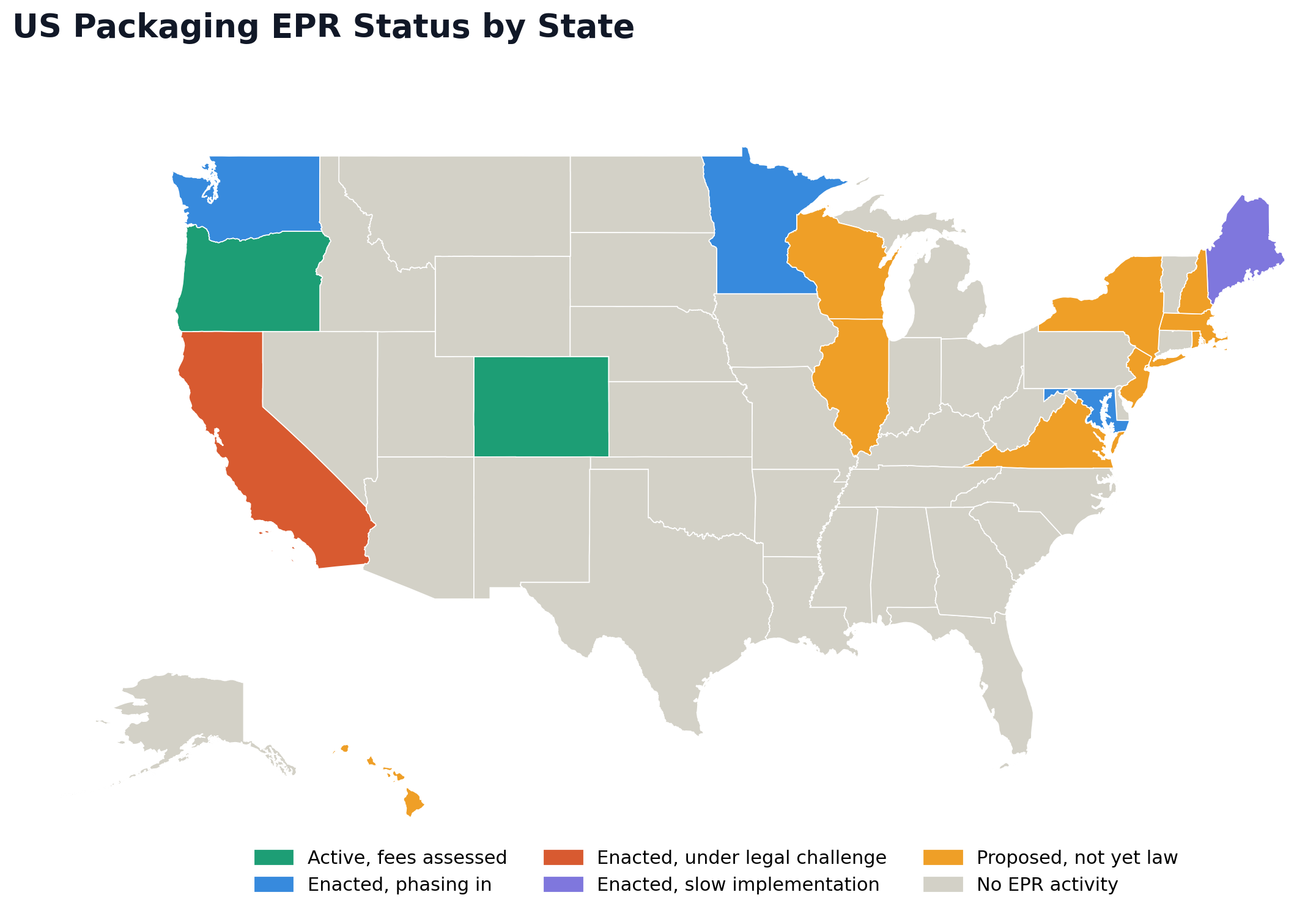
No federal EPR statute exists in the United States, so obligations are set entirely at the state level. Seven states have enacted packaging EPR laws: Maine, Oregon, Colorado, California, Minnesota, Maryland, and Washington, according to law firm Holland & Knight. Maine and Oregon were the earliest adopters, each passing its packaging EPR law in 2021, per the Maine Department of Environmental Protection, with the remaining five states following in subsequent years.
Regulatory Breakdown
US State-by-State Packaging EPR Snapshot
Sources: Holland & Knight, “The Latest Pandora’s Box: What You Need to Know Now About State EPR Laws,” January 2026; Holland & Knight, “Are You Ready to Report Your Packaging Data Next Month?,” April 2026; Holland & Knight, “2026 EPR Reporting: Lessons Learned from the Initial Consolidated Reporting Round,” July 2026; Proskauer Rose, “Seven States and Counting: The 2025 Guide to EPR Packaging Compliance”; Printing United Alliance, “Six States Face Packaging EPR Reporting Deadline on May 31,” May 2026; Maine Department of Environmental Protection, “Extended Producer Responsibility for Packaging.” Enactment years not specified in sourced material for Colorado, California, Minnesota, Maryland, or Washington are left blank rather than estimated.
Implementation timelines vary considerably by state. Colorado’s EPR plan took effect January 1, 2026, marking the state’s first year of mandatory producer fees, and Colorado and Oregon producers had already received fee invoices based on prior supply reports by that January, after both states published their fee schedules in October 2025. California’s SB 54 regulations became effective May 1, 2026, with registration due June 1, 2026, and a baseline data report due July 1, 2026; producers there must also be approved into the state’s PRO plan by January 1, 2027, ahead of a full compliance target of 2032. The Circular Action Alliance is now the approved producer responsibility organization in six of the seven enacted states; Maine remains the exception, with its Department of Environmental Protection issuing a request for proposals for a stewardship organization on June 15, 2026. (Sources: Holland & Knight, Holland & Knight, Holland & Knight, Proskauer Rose.)
Producers in California, Colorado, and Oregon must also submit more detailed supply reports by May 31, 2026, which will be used to calculate the next fee cycle beginning in 2027. Minnesota, Maryland, and Washington require a simpler Supply Report by the same date, using 2025 data, and are not expected to begin assessing fees before 2028, according to Printing United Alliance.

How Do EU and US EPR Requirements Compare by Industry?
Packaging is the most mature EPR category in both regions, though the EU applies a single regulation while the US relies on seven separate state statutes. Batteries and electronics are well established across the EU under the Battery Regulation and WEEE rules, whereas the US has not adopted a comparable federal standard; battery and electronics EPR in the US remain state-by-state initiatives.
Textiles represent the newest frontier in both regions, and California is currently ahead of the rest of the US. The state’s Responsible Textile Recovery Act selected Landbell USA to manage a program set to begin in 2030, with PRO applications due January 1, 2026, producer registration by July 1, 2026, and earliest possible implementation by July 1, 2028, according to Waste Dive and Printing United Alliance. New York and Washington are considering similar legislation. The EU, by contrast, is actively extending its EPR model into new categories, most recently vehicles, giving it broader structural momentum even without a single confirmed textile deadline. Beyond the seven enacted US states, Holland & Knight reports that at least two additional states introduced EPR legislation in 2026, with several others maintaining existing proposals.
Regulatory Breakdown
EU vs. US EPR Industry Coverage
Sources: Recycling Europe, “EP Plenary Greenlights ELV Deal,” June 2026; Waste Dive, “Key EPR laws and right-to-repair updates moved forward in July,” July 2026; Printing United Alliance, “The State of Textile EPR Legislation in the U.S.,” February 2026.
Key EPR Dates and Deadlines: EU and US, 2026 to 2027
Regulatory Breakdown
Key EPR Dates and Deadlines: EU and US, 2026 to 2027
EU
February 11, 2025
PPWR enters into force.
June 18, 2026
European Parliament approves the End-of-Life Vehicles Regulation, extending EPR to vehicles.
August 12, 2026
PPWR becomes applicable; producer registers and recyclability-linked fees begin.
2029
Deposit-and-return systems mandatory for certain single-use beverage containers.
US
January 1, 2026
Colorado’s EPR plan takes effect; Colorado and Oregon producers receive their first fee invoices based on prior supply data.
May 1, 2026
California SB 54 regulations become effective.
May 31, 2026
Supply Report deadline for California, Colorado, Oregon, Minnesota, Maryland, and Washington.
June 1, 2026
California producer registration deadline.
June 15, 2026
Maine’s Department of Environmental Protection issues its stewardship organization RFP.
June 22, 2026
A 17-state coalition sues California in federal court, challenging SB 54’s constitutionality.
July 1, 2026
California textile EPR registration deadline; packaging baseline data report due.
January 1, 2027
California deadline for producer approval into the packaging PRO plan.
2027
California, Colorado, and Oregon calculate the next fee cycle from the detailed supply reports submitted in 2026.
2028
Earliest expected fees for Minnesota, Maryland, and Washington; earliest possible textile EPR implementation in California.
2030
California’s textile EPR program begins operation.
2032
California SB 54’s full packaging compliance target.
Sources: EUROPEN, “Extended Producer Responsibility” (accessed 2026); Faegre Drinker, “Significant New Obligations for Manufacturers Placing Packaging on the EU Market,” July 2026; Recycling Europe, “EP Plenary Greenlights ELV Deal,” June 2026; Holland & Knight, “2026 EPR Reporting: Lessons Learned from the Initial Consolidated Reporting Round,” July 2026; Holland & Knight, “California’s Final EPR Regulations Now in Effect,” May 2026; Holland & Knight, “States, Industry Groups and Environmental Advocates Challenge California Plastics Rule,” June 2026; Printing United Alliance, “Six States Face Packaging EPR Reporting Deadline on May 31,” May 2026; Proskauer Rose, “Seven States and Counting: The 2025 Guide to EPR Packaging Compliance”; Maine Department of Environmental Protection, “Extended Producer Responsibility for Packaging.”
What Should Multinational Producers Do Next?
An EU regulation and seven independent US state statutes still converge on the same operational demands: registration, SKU-level or material-level data, and recyclability-linked fees. The underlying data requirement is functionally the same whether the obligation originates in Brussels or Sacramento, which means treating each jurisdiction as a separate compliance project tends to duplicate effort and produce inconsistent data. A single compliance data architecture, one that captures packaging and material composition once and maps it to each jurisdiction’s specific format, is a more defensible operating model as both regions add new product categories and tighten deadlines through 2027 and beyond.
Conclusion
EPR is becoming a cross-industry, cross-jurisdiction reporting obligation touching packaging, batteries, electronics, and increasingly textiles and vehicles across two continents with different legal architectures but converging data demands. Executive teams that treat EPR as one global data challenge, rather than seven state filings plus one EU regulation handled separately, will be better positioned for the fee and reporting cycles arriving in 2027 and 2028. ASUENE’s carbon and compliance data platform helps sustainability and finance teams centralize the material, packaging, and supply chain data both EU and US EPR regimes require, turning a fragmented compliance calendar into a single, auditable system. Executive teams evaluating their EPR exposure should map their product portfolio against these jurisdictions now, ahead of the 2027 fee cycles.
Frequently Asked Questions
Sources
References
- EUROPEN — “Extended Producer Responsibility”
- Greenberg Traurig LLP — “EU Packaging and Packaging Waste Regulation: New Compliance Requirements for E-Commerce,” August 2025
- Faegre Drinker — “Significant New Obligations for Manufacturers Placing Packaging on the EU Market,” July 2026
- Recycling Europe — “EP Plenary Greenlights ELV Deal, Europe Must Now Build the Market to Deliver It,” June 2026
- Holland & Knight — “The Latest Pandora’s Box: What You Need to Know Now About State EPR Laws,” January 2026
- Holland & Knight — “Are You Ready to Report Your Packaging Data Next Month?,” April 2026
- Holland & Knight — “California’s Final EPR Regulations Now in Effect,” May 2026
- Holland & Knight — “2026 EPR Reporting: Lessons Learned from the Initial Consolidated Reporting Round,” July 2026
- Holland & Knight — “States, Industry Groups and Environmental Advocates Challenge California Plastics Rule,” June 2026
- Proskauer Rose LLP — “Seven States and Counting: The 2025 Guide to EPR Packaging Compliance”
- Printing United Alliance — “Six States Face Packaging EPR Reporting Deadline on May 31,” May 2026
- Printing United Alliance — “The State of Textile EPR Legislation in the U.S.,” February 2026
- Waste Dive — “Key EPR laws and right-to-repair updates moved forward in July,” July 2026
- Maine Department of Environmental Protection — “Extended Producer Responsibility for Packaging”
Why Work with ASUENE Inc.?
ASUENE is a key player in carbon accounting, offering a comprehensive platform that measures, reduces, and reports emissions, including Scope 1-3. ASUENE serves over 56,000 clients worldwide, providing an all-in-one solution that integrates GHG accounting, ESG supply chain management, a Carbon Credit exchange platform, and third-party verification.
ASUENE supports companies in achieving net-zero goals through advanced technology, consulting services, and an extensive network.