- Article Summary
-
Introduction
After an all-night negotiation, EU Environment and Climate Ministers struck a landmark deal introducing a legally binding 2040 target to cut net greenhouse gas emissions by 90 percent compared to 1990 levels. While this announcement marks a crucial milestone on the path to climate neutrality by 2050, another part of the agreement raises deeper questions: the postponement of the EU Emissions Trading System for road transport and buildings (ETS2) by one year, from 2027 to 2028.
This delay, described as a pragmatic choice to ensure a smoother rollout, reveals a growing tension between political feasibility and climate urgency. The compromise aims to protect households and small businesses from volatile carbon prices, but it could weaken one of Europe’s most powerful tools for decarbonization.
What Is ETS2 and Why It Matters
The EU Emissions Trading System (ETS) is the cornerstone of Europe’s climate policy, placing a price on carbon emissions from power plants, industry, and aviation. ETS2 extends this cap-and-trade mechanism to road transport and buildings, sectors responsible for roughly one-third of EU emissions.
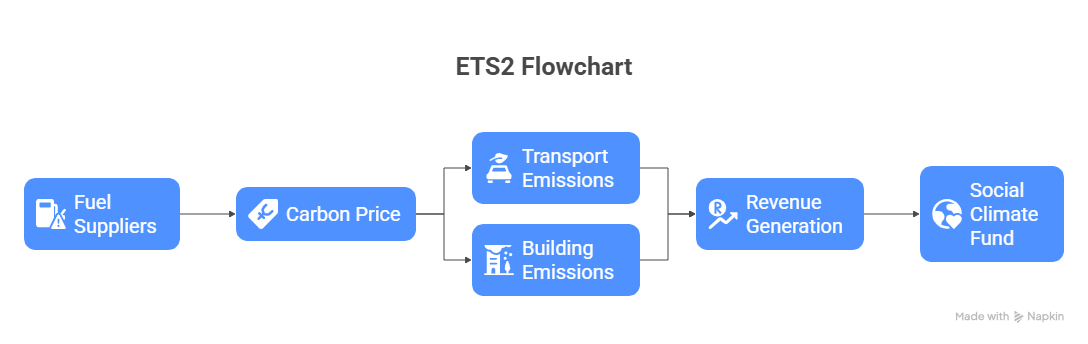
Unlike the main ETS, ETS2 targets emissions from fuel suppliers, who pass costs downstream to consumers. Its purpose is to encourage energy efficiency and cleaner transport, create consistent carbon pricing across the economy, and fund climate and social measures through the Social Climate Fund (SCF), designed to offset the impact on vulnerable groups.
Originally set to start in 2027, ETS2 was expected to transform Europe’s carbon pricing landscape by making households, transport operators, and small businesses part of the transition.
For further details on ETS2, check out another blog from us → How ETS2 Will Transform Carbon Pricing in Buildings and Road Transport
The One-Year Delay: A Political Compromise with Climate Costs
Under pressure from Member States concerned about inflation and energy affordability, the EU agreed to delay ETS2 until 2028. Officials argue this will prevent social backlash similar to the yellow vest protests that shook France in 2018.
However, the cost of postponement is steep:
- Lost momentum: One year means tens of millions of tonnes of additional CO₂ emissions from cars, trucks, and inefficient buildings.
- Weaker price signals: Companies and consumers lose an early incentive to invest in cleaner vehicles and heat pumps.
- Policy credibility: The EU’s message to global partners weakens just before COP30, where the 2040 target will be showcased as proof of leadership.
Economic and Industrial Implications
The delay reshapes carbon market dynamics. Analysts expect a temporary drop in demand for carbon allowances, potentially lowering ETS prices. This could reduce revenues for the Social Climate Fund, which depends on auctioning ETS2 credits to finance support measures for low-income households.
For industry, the delay may bring mixed signals:
- Short-term relief for fuel suppliers and heating providers who face lower compliance costs.
- Long-term uncertainty for companies aligning their strategies with EU carbon pricing.
- Competitive distortion between sectors covered by the original ETS and those now left out another year.

A Step Back from Leadership
The EU has long been the global benchmark for climate regulation, using policy ambition to push international markets forward. Yet this delay, announced alongside the 2040 target, illustrates how political caution now shapes Europe’s climate path.
The optics are complex:
- The 90 percent reduction target sets a bold vision for 2040.
- Delaying ETS2 undercuts the near-term mechanisms needed to achieve it.
This dual message of high ambition and slower execution risks eroding trust among investors, trading partners, and developing economies looking to the EU for direction. As global attention turns toward COP30, the credibility of Europe’s climate model will depend not only on targets, but on its ability to deliver consistent and timely policy implementation.
Conclusion
The EU’s 2040 deal shows that climate ambition and political pragmatism must constantly coexist. But climate physics does not compromise. By delaying ETS2, Europe has bought itself one year of social cushioning, but at the price of reduced carbon discipline and weaker market signals.
To maintain its leadership, the EU will need to use that extra year wisely: strengthen the Social Climate Fund, improve communication with citizens, and ensure that when ETS2 launches in 2028, it does so with the public trust and resilience to last. In the race to net zero, even a one-year delay matters.
Why Work with ASUENE Inc.?

ASUENE is a key player in carbon accounting, offering a comprehensive platform that measures, reduces, and reports emissions. ASUENE serves over 10,000 clients worldwide, providing an all-in-one solution that integrates GHG accounting, ESG supply chain management, a Carbon Credit exchange platform, and third-party verification.
ASUENE supports companies in achieving net-zero goals through advanced technology, consulting services, and an extensive network.