
- Article Summary
-
Introduction
In December 2025, the European Commission presented the Automotive Package, proposing revisions to the Regulation on CO2 standards for cars and vans. The proposal keeps the 55% CO2 reduction target for passenger cars by 2030, lowers the vans target from 50% to 40%, and replaces the previous 2035 zero-emission requirement with a 90% tailpipe emissions reduction target.
These standards determine how many zero-emission vehicles must be sold in the EU by 2030. Automakers face financial penalties if their fleet-average emissions exceed the limits, meaning compliance depends directly on electric vehicle sales volumes. Recent analysis by Transport & Environment examines whether strengthening the proposed EU Fleets Law could materially increase guaranteed EV sales and reduce the projected compliance gap before 2030.
Key Takeaways
- The EU Automotive Package maintains a 55% CO2 reduction target for cars and adjusts the vans target to 40% by 2030.
- Automakers must significantly increase electric vehicle sales to comply with fleet-average CO2 limits.
- A 45% fleet electrification target would secure about 37% of required EV sales for 2030 compliance.
- Raising the fleet target to 69% and excluding plug-in hybrids could secure around 57% of required EV sales.
- An ambitious fleet target could generate up to 2 million additional EV registrations by 2030.
EU 2030 CO2 Targets and the Electric Vehicle Compliance Gap
Under EU CO2 standards, manufacturers must meet fleet-average emission limits across all new vehicles sold annually. With the 2030 target set at a 55% reduction for cars and 40% for vans, compliance requires a substantial increase in the share of zero-emission vehicles in total sales.
For automakers, the challenge is both technological and commercial in scale. Meeting the 2030 CO2 target means ensuring that electric vehicles represent a sufficiently large portion of total registrations across the EU. If EV uptake slows or remains uneven across Member States, manufacturers risk exceeding their fleet-average limits and facing financial penalties.
The 2025 Automotive Package introduces additional flexibility, particularly for vans, yet it does not remove the core compliance obligation. Manufacturers must still ensure that EV sales volumes increase rapidly enough to align with fleet-average CO2 limits. The gap between projected market uptake and required compliance volumes remains a central concern for the industry as 2030 approaches.
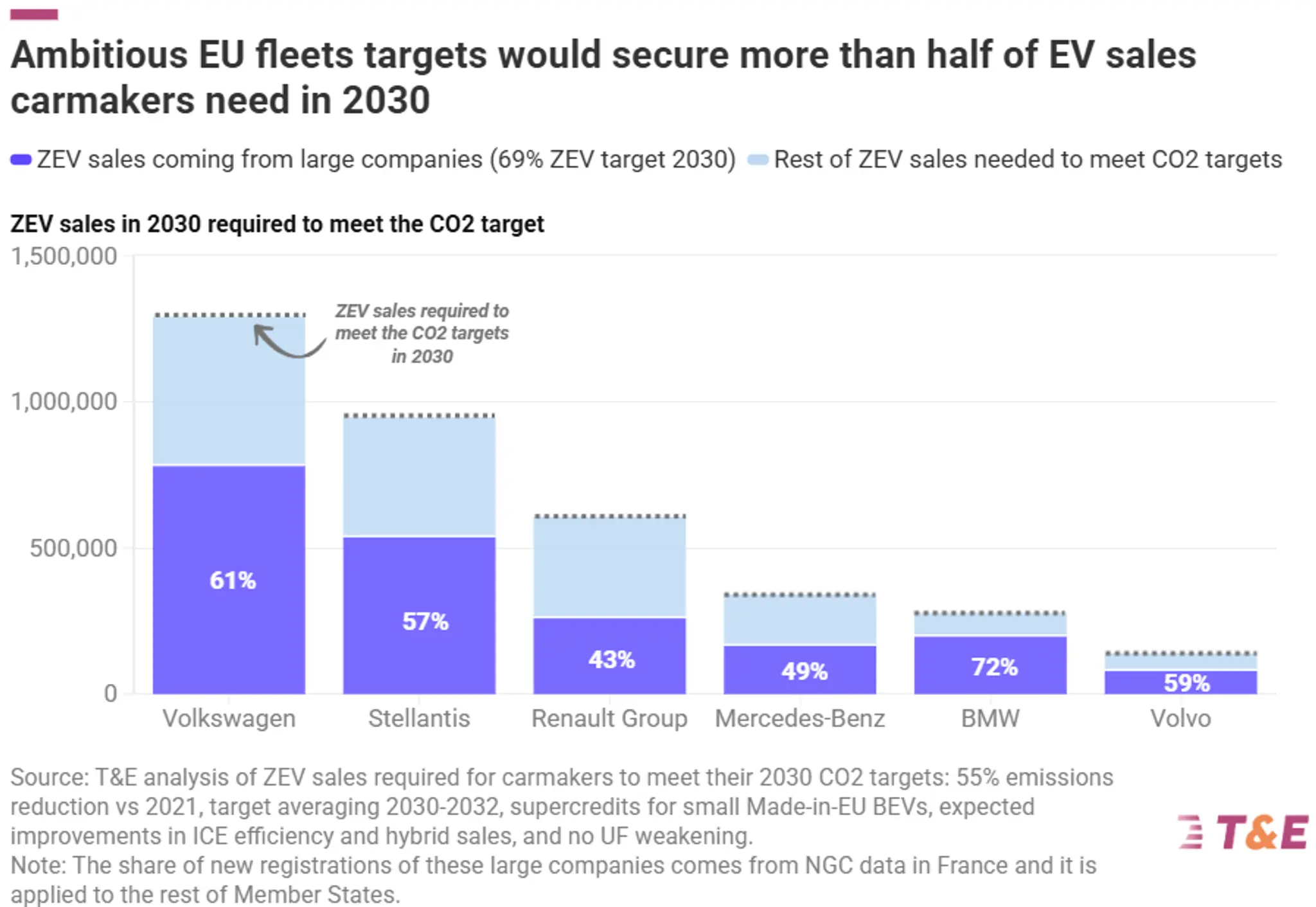
45% vs 69% Fleet Target: Compliance Impact
The proposed EU Fleets Law sets an average 45% electrification target for new cars registered by large companies across Member States. Transport & Environment estimates that this level would secure around 37% of the electric vehicle sales required for manufacturers to meet their 2030 CO2 targets, leaving a substantial share of the compliance gap unresolved.
T&E analysed a higher ambition scenario aligned with the EU’s own Impact Assessment, increasing the electrification target to 69% and excluding plug-in hybrids. Under this scenario, an ambitious company cars law could deliver around 57% of the EV sales needed for compliance, equivalent to roughly 2 million additional electric vehicle registrations.

Market Evidence and Industrial Implications
Sofie Grande y Rodriguez, Clean Fleets Manager at T&E, stated that lawmakers face a clear choice: increase EV targets and exclude plug-in hybrids, or limit the law’s demand-driving potential. T&E argues that stronger targets would better align with the interests of the European car industry.
Evidence from Member States illustrates how policy design affects uptake. Belgium reformed fiscal rules for company cars in 2021 by phasing out depreciation write-offs for internal combustion vehicles and plug-in hybrids, leading EV corporate registrations to reach 54% in 2025. In Germany, where comparable reform was not implemented, EVs accounted for 19% of the corporate market.
T&E also notes that 74% of new corporate EVs registered in the EU in 2025 were produced in Europe. Under a 69% EV-only fleet target, European carmakers could sell up to 1.9 million additional EVs in 2030, compared to a maximum of 1.2 million additional Made-in-EU EVs under the 45% target.
Conclusion
The EU Automotive Package and existing CO2 standards establish clear legal requirements for reducing emissions from new cars and vans by 2030. Achieving these targets depends on reaching specific electric vehicle sales volumes within a limited timeframe.
Transport & Environment’s research indicates that an EU Fleets Law could deliver 57% of the EV sales needed for 2030 compliance. By targeting corporate and rental fleets, the measure focuses on a structurally influential segment of the market capable of closing a majority share of the projected EV sales gap.
As Europe advances toward its 2030 milestone, fleet electrification stands out as a central mechanism for aligning electric vehicle market growth with legally binding CO2 reduction targets.
Why Work with ASUENE Inc.?

ASUENE is a key player in carbon accounting, offering a comprehensive platform that measures, reduces, and reports emissions. The company serves over 10,000 clients worldwide with an all-in-one solution that integrates GHG accounting, ESG supply chain management, a Carbon Credit exchange platform, and third-party verification.
ASUENE supports companies in achieving net-zero goals through advanced technology, consulting services, and an extensive network.