- Article Summary
-
Introduction
Seven U.S. states now enforce Extended Producer Responsibility laws for packaging, and 2026 is the year these regulations moved from legislation into active compliance and enforcement. For C-suite executives, ESG strategists, and corporate planning managers, the question has moved past whether circular economy regulation will affect operations. It is now whether your organization has the data infrastructure and compliance strategy to manage it across multiple jurisdictions simultaneously.
Key Takeaways
- Seven U.S. states have enacted EPR packaging laws. All seven required producer reporting by May 31, 2026, creating the first simultaneous multi-state compliance deadline in EPR history.
- California’s SB 54 took effect on May 1, 2026, covering more than 5,700 producers with noncompliance penalties of up to $50,000 per day.
- Oregon has moved into active enforcement, publicly listing noncompliant producers and referring cases to the state Department of Environmental Quality.
- The packaging data required for EPR reporting overlaps directly with Scope 3 emissions accounting, creating strategic leverage for companies that integrate both compliance workstreams.
- Additional state legislation and federal proposals are expanding the regulatory perimeter, making proactive multi-jurisdiction planning an executive priority.
What Are State Circular Economy Regulations and Why Should Executives Act Now?
State circular economy regulations represent a fundamental shift in how the United States manages packaging waste, moving financial and operational responsibility from municipalities to the companies that produce, import, or sell packaged goods. At the center of this shift is Extended Producer Responsibility, a policy framework that requires producers to fund and manage the collection, recycling, and disposal of their packaging materials throughout the entire product lifecycle.
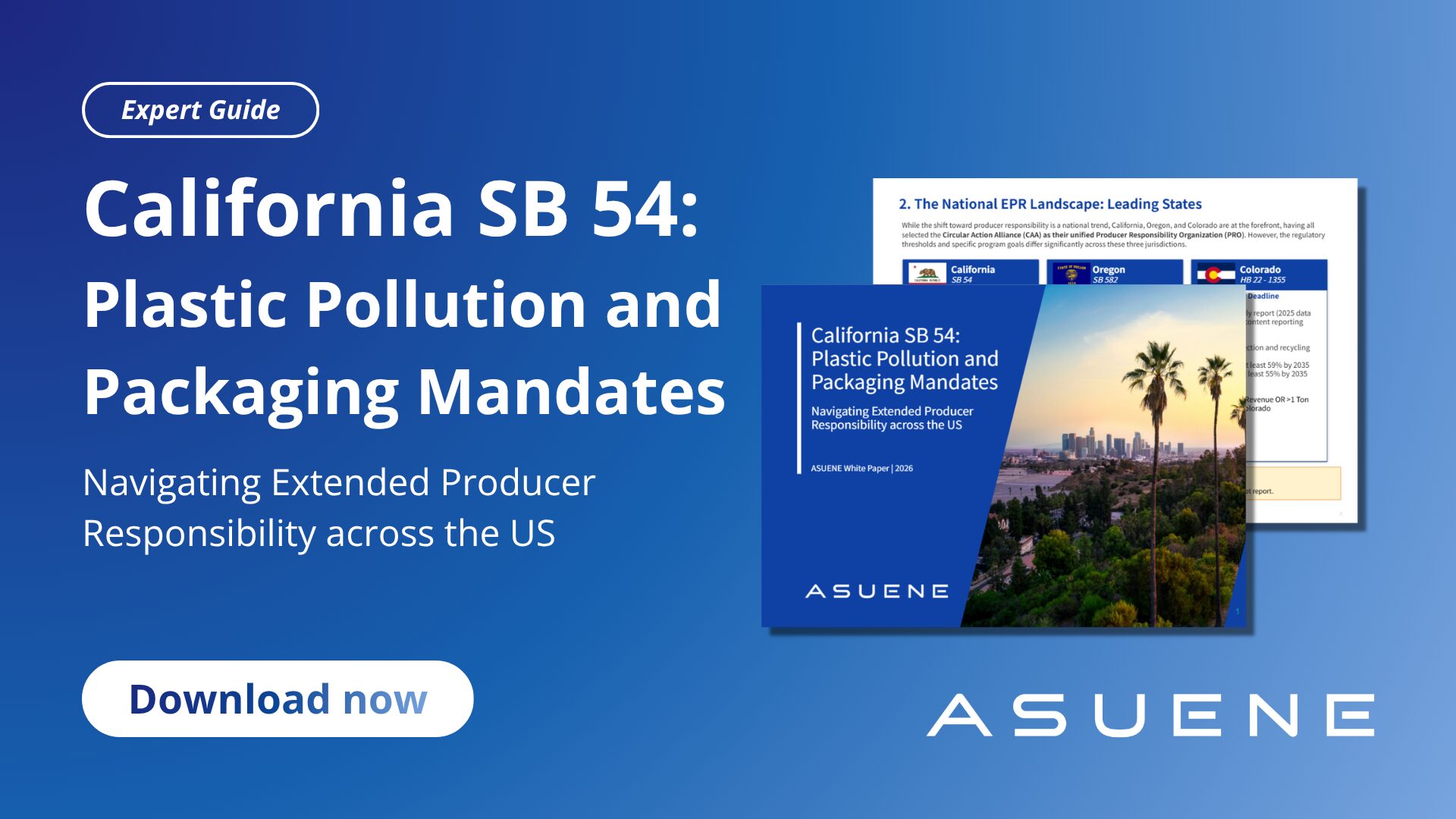
The regulatory momentum in 2026 is unlike any previous year. Seven states have enacted comprehensive EPR legislation for packaging and paper products: Maine, Oregon, Colorado, California, Minnesota, Maryland, and Washington. All seven required producers to register or submit supply data reports by May 2026. This marks the first time multiple state EPR programs have imposed simultaneous compliance deadlines, creating a new category of regulatory risk for companies that sell packaged goods across state lines.
The scope of affected businesses is substantial. California alone estimates that more than 5,700 producers fall under SB 54 obligations. When factored across all seven states, the number of companies with at least one EPR reporting obligation runs significantly higher. Producers are broadly defined under these laws and can include manufacturers, brand owners, importers, and in some cases, retailers who sell private-label products.
For executive decision-makers, the key takeaway is that EPR compliance is not a packaging team issue or a sustainability department project. It is a data management, financial planning, and legal risk challenge that requires cross-functional coordination and C-suite oversight.
The Seven-State EPR Landscape: From California SB 54 to Washington SB 5284
The seven enacted EPR programs share a common objective of shifting packaging waste costs to producers, but they differ meaningfully in scope, reporting requirements, fee structures, and implementation timelines. Companies operating in multiple states face a patchwork of obligations that demand jurisdiction-specific compliance strategies.
California, Colorado, and Oregon represent the most advanced programs. All three require detailed Annual Supply Reports with SKU-level and component-level packaging data. This means producers must report the specific material composition, recyclability classification, and volume of each packaging component sold into each state, going well beyond total weight figures. These detailed reports serve as the basis for calculating producer fees beginning in 2027 for California and already active in Oregon and Colorado.
Minnesota, Maryland, and Washington accepted simplified supply reports for the May 2026 deadline, using aggregated material weight data rather than SKU-level detail. However, this simplified reporting is a temporary measure. As these programs mature, reporting granularity is expected to increase.
The Circular Action Alliance serves as the approved Producer Responsibility Organization in California, Colorado, Oregon, Minnesota, and Maryland. Maine and Washington have yet to select a designated PRO. In practice, CAA registration and compliance is the primary pathway for most producers, although each state technically offers an independent compliance option that is cost-prohibitive for all but the largest companies.
Additional EPR legislation is advancing. New Hampshire and Wisconsin introduced EPR bills in 2026, with pending proposals in Hawaii, Illinois, New York, New Jersey, and Massachusetts. For companies with national distribution, the question is not whether additional states will follow, but how quickly.
How Do EPR Penalties and Enforcement Risks Affect Corporate Operations?
The enforcement landscape for EPR noncompliance has moved from theoretical to operational. Penalty structures vary by state, but the financial exposure is material across all active programs.
California imposes the most severe penalties. Under SB 54, producers found to be noncompliant face administrative civil penalties of up to $50,000 per day for each violation. Given that the permanent regulations took effect on May 1, 2026, and registration was required by June 1, any producer that missed the deadline is accumulating daily penalty exposure.
Oregon’s enforcement trajectory is the most advanced. The Oregon Department of Environmental Quality has begun publishing lists of noncompliant producers, and the Circular Action Alliance has referred unresolved delinquencies to DEQ for enforcement action. DEQ can assess civil penalties of up to $25,000 per day and can request that the Oregon Department of Justice seek orders prohibiting noncompliant producers from selling covered products in or into Oregon. A sales prohibition represents a more disruptive business risk than financial penalties alone.
Beyond direct penalties, reputational risk is emerging as a compliance factor. Oregon’s decision to publish the names of noncompliant producers creates public accountability that can affect brand perception, investor confidence, and customer relationships. As more states develop enforcement mechanisms, this transparency is likely to become standard practice.
Legal challenges are also part of the landscape. The National Association of Wholesaler-Distributors has filed suit against Oregon’s Recycling Modernization Act, and a similar challenge is underway in Colorado with trial scheduled for July 2026. However, these legal challenges offer limited protection. The Oregon preliminary injunction applies only to NAW members as of February 6, 2026. All other producers remain fully subject to enforcement.
How Does Circular Economy Compliance Connect to Scope 3 Emissions Strategy?
One of the most underrecognized aspects of the EPR compliance wave is its overlap with corporate carbon accounting. The packaging data that producers must collect for EPR reporting, including material types, weights, recyclability classifications, and supply volumes, is substantially the same data required for accurate Scope 3 emissions calculations under the GHG Protocol.
Scope 3 emissions, which encompass indirect emissions across a company’s value chain, frequently represent the largest share of total corporate carbon footprint. Research from CDP and Boston Consulting Group found that corporate supply chain emissions are, on average, 26 times higher than operational emissions. Despite this, only 15% of companies had set a supply chain emissions target at the time of reporting.
For companies subject to EPR obligations, the Scope 3 connection creates both a challenge and an opportunity. The challenge is that building the data infrastructure to support EPR compliance is resource-intensive, requiring SKU-level material data, supplier engagement, and cross-functional coordination between sustainability, procurement, legal, and operations teams. The opportunity is that this same infrastructure, once built, directly feeds Scope 3 Category 1 (Purchased Goods and Services) and Category 5 (Waste Generated in Operations) calculations.
Companies that treat EPR compliance and Scope 3 reporting as integrated workstreams rather than parallel projects can reduce duplication of effort, improve data quality across both functions, and create a unified data foundation that supports regulatory compliance, investor disclosure, and decarbonization planning simultaneously.
Preparing for Regulatory Expansion: Right-to-Repair, Recycled Content Mandates, and Federal Signals
EPR for packaging is the most mature pillar of U.S. circular economy regulation, but it is not the only one advancing. Executives should monitor three additional regulatory trajectories that are expanding the compliance perimeter.
Right-to-repair laws took effect in Colorado, Nevada, Oregon, and Washington on January 1, 2026. These laws require manufacturers to provide parts, tools, and documentation to independent repair providers and prohibit parts pairing, the practice of linking components to specific devices to restrict third-party repair. For companies in the electronics, appliances, and mobility device sectors, these laws introduce new obligations around product design, spare parts inventory, and service provider relationships. Additional right-to-repair legislation is advancing in multiple states, and advocacy groups describe 2026 as another significant legislative year.
Recycled content mandates are tightening at the state level. Maine has enacted post-consumer recycled content requirements for plastic beverage containers with registration fees starting in January 2026. California updated its state procurement law to require agencies to purchase recycled products at up to 10% higher cost than non-recycled alternatives. Minnesota’s EPR framework includes a 2032 standard under which covered products must be reusable, refillable, recyclable, or compostable.
At the federal level, bipartisan lawmakers introduced the Recycled Materials Attribution Act in February 2026, seeking to establish consistent national standards for recycled content marketing claims. While federal circular economy legislation has historically lagged behind state action, the RMAA and the earlier CIRCLE Act signal increasing congressional engagement. The CIRCLE Act proposed tax credits for private investment in recycling infrastructure, reflecting a strategy to reduce U.S. dependence on foreign critical materials.
The combined trajectory of these regulatory developments points in one direction: the compliance surface area for circular economy obligations is expanding, and companies that build scalable, integrated data and compliance systems now will be better positioned than those that respond to each new mandate reactively.
Conclusion
The 2026 EPR compliance wave marks a turning point for U.S. circular economy regulation. Seven states are now operating active programs, enforcement has begun, and penalties for noncompliance are material. For executive decision-makers, the strategic imperative is clear: circular economy compliance requires the same level of C-suite attention, cross-functional coordination, and data infrastructure investment that companies have applied to financial reporting and cybersecurity.
The companies that will navigate this regulatory environment most effectively are those that recognize the overlap between EPR compliance and Scope 3 emissions strategy, build integrated data systems that serve both functions, and treat regulatory expansion as a planning assumption rather than a surprise.
- CalRecycle. SB 54 Rulemaking: Circular Economy for Plastic Packaging. View source
- Freshfields Bruckhaus Deringer. California’s EPR Regulations in Effect: What You Need to Know. View source
- Circular Action Alliance. California EPR Program. View source
- CalRecycle. Packaging EPR: Producer Application Portal. View source
- Oregon Department of Environmental Quality. Producers of Covered Products. View source
Why Work with ASUENE Inc.?

ASUENE is a key player in carbon accounting, offering a comprehensive platform that measures, reduces, and reports emissions, including Scope 1-3. ASUENE serves over 10,000 clients worldwide, providing an all-in-one solution that integrates GHG accounting, ESG supply chain management, a Carbon Credit exchange platform, and third-party verification.
ASUENE supports companies in achieving net-zero goals through advanced technology, consulting services, and an extensive network.