- Article Summary
-
Introduction
The aviation sector is entering a decisive phase in its climate transition. Governments, regulators, and international organizations are accelerating policy frameworks that influence how airlines reduce emissions and scale sustainable technologies. The 2026 outlook highlights six major policy trends shaping aviation decarbonization strategies across fuel supply, regulatory coordination, and industry investment.
Key Takeaways
- Aviation decarbonization policy momentum is accelerating globally as governments align with international climate targets.
- Sustainable aviation fuel (SAF) is widely identified as the primary near‑term emissions reduction lever for the aviation sector.
- Carbon market mechanisms and international coordination frameworks continue to shape airline climate strategies.
- Regional policy frameworks in the United States, Europe, and Asia are evolving through different regulatory and investment approaches.
What Is Driving Aviation Decarbonization Policy in 2026?
The aviation sector faces increasing pressure to align with global climate targets while continuing to support economic activity and international mobility. Recent international aviation policy discussions emphasize the implementation of measures agreed through the International Civil Aviation Organization (ICAO), including sustainable aviation fuels, monitoring of emissions progress, and market‑based mechanisms such as the Carbon Offsetting and Reduction Scheme for International Aviation (CORSIA).
Delegations from ICAO member states continue to coordinate policies and implementation measures designed to achieve the sector’s long‑term goal of net‑zero carbon emissions by 2050. International policy frameworks therefore play a central role in guiding the transition.
Aviation Decarbonization Outlook 2026: 6 Global Policy Themes
Policy frameworks are the primary driver of aviation decarbonization in 2026. The following six themes reflect the most critical policy developments shaping aviation decarbonization strategies for airlines and fuel suppliers.
Theme 1: Global Net Zero Alignment Under ICAO (LTAG)
ICAO’s LTAG commits international aviation to net‑zero carbon emissions by 2050 and anchors policy across 193 member states. The Assembly reaffirmed this target and advanced standardized monitoring and reporting methodologies, giving airlines a consistent baseline for compliance planning and capital allocation.
Theme 2: SAF Policy Frameworks and Deployment Targets
Policy focus has shifted to scaling SAF through the ICAO Global Framework for SAF, LCAF and other cleaner energies, targeting a 5% CO2 reduction in international aviation by 2030. Governments are aligning regional clusters, standardizing SAF definitions and sustainability labels, and providing post‑2035 policy certainty to support final investment decisions.
Theme 3: Market-Based Mechanisms for Emissions Management
CORSIA, the Carbon Offsetting and Reduction Scheme for International Aviation, is the only global market-based mechanism designed specifically for international aviation. It requires airlines to monitor, report, and offset emissions growth above baseline levels, creating a standardized global compliance system.
Alongside CORSIA, regional systems such as the EU Emissions Trading System introduce carbon pricing that assigns a direct financial cost to emissions. This directly impacts airline cost structures and incentivizes lower-emission solutions such as SAF adoption and operational efficiency.
Theme 4: Energy Security and Feedstock Availability Policies
Energy security is driving concrete policy shifts toward fossil‑free aviation fuels. In the United States, policy adjustments have expanded eligible SAF feedstocks to lower costs and accelerate domestic production, prioritizing energy independence over strict sustainability criteria. In Europe, stricter sustainability rules and supply chain controls aim to secure high‑integrity fuel supply. This divergence reflects a core policy tension: scaling SAF quickly while maintaining sustainability standards.
Theme 5: Trade Policy and Cross-Border Fuel Flows
Trade policy is directly shaping cross-border flows of SAF and feedstocks. Evolving tariffs and divergent sustainability criteria are fragmenting markets, affecting where fuels are produced and how they move across regions. This constrains efficient allocation of supply and raises delivered fuel costs.
Key risks to monitor include restricted cross-border feedstock flows, inconsistent certification standards that limit fungibility, and price volatility driven by tariff changes. For airlines and fuel producers, securing diversified sourcing and aligning with compliant supply corridors is becoming critical to maintain cost competitiveness and reliable supply.
Theme 6: Multilateral Coordination and Policy Harmonization
Geopolitical shifts are reducing the effectiveness of multilateral institutions and slowing global policy alignment on energy transition. Despite this, aviation continues to maintain coordination under ICAO, with the 42nd Assembly reaffirming commitments to LTAG and sector decarbonization.
This dynamic highlights a key reality: while global alignment is more difficult, aviation remains one of the few sectors sustaining multilateral cooperation. Maintaining ICAO-led coordination is therefore critical to avoid fragmented national policies and ensure consistent global decarbonization progress.

How Are Aviation Decarbonization Policies Evolving by Region?
Regional policy development is accelerating, but approaches remain highly differentiated. The 2026 outlook highlights how governments are balancing industrial competitiveness, energy security, and emissions reduction targets through distinct policy frameworks. These differences directly affect SAF scaling, cost structures, and cross-border market dynamics.
United States: Scaling Supply Through Incentives and Domestic Feedstocks
US policy is focused on scaling domestic SAF production through tax incentives and feedstock prioritization. The 45Z tax credits have been extended to 2029, with eligibility limited to US, Mexican, and Canadian feedstocks, reinforcing energy security and domestic industry growth.
Expanded biofuel mandates and lifecycle calculation changes are increasing eligible feedstocks such as corn, soybeans, and canola. However, reduced SAF-specific credits and the phase-out of hydrogen and renewable incentives may constrain long-term competitiveness.
Europe: Mandates, Incentives, and Sustainability Standards
Europe has implemented SAF mandates requiring a 2% blend for flights from EU and UK airports starting in 2025, with Switzerland joining in 2026. Demand is rising, but supply constraints remain, especially for e‑SAF, with stricter targets expected after 2030.
The EU’s Sustainable Transport Investment Plan aims to mobilize over €2.9 billion by 2027 to scale production, supported by mechanisms such as e‑SAF auctions and potential ETS support. In the UK, SAF reached 2.36% in 2025, with new policies expected to stabilize revenues and unlock investment.
Asia-Pacific: Targeted Incentives, Mandates, and Export Positioning
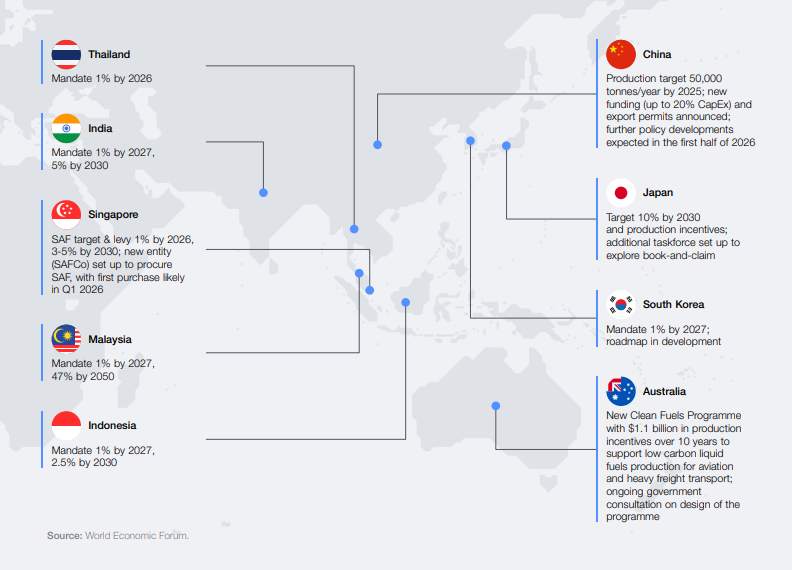
China is accelerating SAF through subsidies of up to 20%, reducing costs by 5–8%, and expanding exports with 1.2 million ton of permits. A domestic SAF mandate is expected, strengthening its position in global supply.
Singapore is introducing a 1% SAF target in 2026, rising to 3–5% by 2030, supported by a levy-funded procurement system. Australia is investing AU$1.1 billion in low-carbon fuels, while Japan combines a 10% SAF target by 2030 with subsidies and industrial policy to scale domestic production.
Middle East and Africa: Policy Formation, Regional Coordination, and Early-Stage Development
In the Middle East, policy development is progressing, with the UAE advancing a SAF mandate and the Gulf Cooperation Council launching a unified aviation authority to support regional alignment. Saudi Arabia and Oman remain in exploratory phases.
In Africa, SAF policy is still emerging. Countries such as Senegal are exploring opportunities through ICAO’s ACT-SAF programme, while Côte d’Ivoire has completed feasibility studies. Industry advocacy is increasing despite limited formal policy implementation.
Cross-Regional Implication: Fragmentation Versus Convergence
Despite growing policy activity, regional divergence remains a defining feature of aviation decarbonization. Differences in sustainability criteria, incentives, and regulatory frameworks are creating fragmented markets. At the same time, increasing pressure for harmonization is emerging, as cross-border fuel flows and global airline operations require greater policy alignment.
What Do These Policy Trends Mean for Aviation Climate Strategy?
Airlines are evaluating how policy frameworks affect fuel procurement strategies, carbon management systems, and capital allocation decisions. Organizations that anticipate policy developments will be better positioned to manage regulatory risk and implement effective decarbonization strategies.
For corporate sustainability leaders, aviation climate policy developments also highlight the growing importance of emissions accounting, supply chain decarbonization, and strategic partnerships across the aviation ecosystem.
Conclusion: Turning Aviation Policy Signals Into Climate Strategy
For aviation leaders and sustainability strategists, understanding these policy signals is essential to building resilient climate strategies. Organizations that monitor evolving aviation policy trends will be better positioned to adapt operations, manage emissions risks, and support the long‑term transition toward sustainable aviation.
Why Work with ASUENE Inc.?

ASUENE is a key player in carbon accounting, offering a comprehensive platform that measures, reduces, and reports emissions, including Scope 1-3. ASUENE serves over 10,000 clients worldwide, providing an all-in-one solution that integrates GHG accounting, ESG supply chain management, a Carbon Credit exchange platform, and third-party verification.
ASUENE supports companies in achieving net-zero goals through advanced technology, consulting services, and an extensive network.